
Conquer Foot Discomfort: Discover the Latest Shockwave Therapy Advancements in White Rock
Persistent foot pain can be more than a minor annoyance; it can fundamentally disrupt daily life, turning simple activities like a walk in White Rock’s beautiful parks or a day of shopping into a daunting task. For many across British Columbia, from Victoria to Cranbrook, chronic conditions like plantar fasciitis or Achilles tendonitis have traditionally meant a long road of conservative treatments with varied success. However, the field of podiatry is witnessing a significant shift, driven by technological advancements that offer new hope. Extracorporeal Shockwave Therapy (ESWT) is at the forefront of this change, providing a non-invasive solution that is redefining recovery for foot-related ailments. Recent data and clinical observations reveal not just its effectiveness, but also its evolution, making it a critical tool for podiatrists in White Rock and beyond.
What industry professionals know is that not all foot pain responds to stretching, icing, or even custom orthotics. For these stubborn, chronic cases, a modality that can stimulate healing at the cellular level is required. Shockwave therapy does precisely that. By delivering acoustic waves to injured soft tissue, it triggers the body’s natural repair mechanisms, increasing blood flow and promoting tissue regeneration. This approach moves beyond mere symptom management to address the root cause of the discomfort, offering a more definitive and lasting solution for patients in communities from Nanaimo to Surrey.
The Professional’s Guide to Modern Shockwave Therapy
Extracorporeal Shockwave Therapy (ESWT) has transitioned from a novel concept to a mainstay treatment for a variety of chronic musculoskeletal and soft-tissue disorders affecting the foot and ankle. Industry case studies across Canada demonstrate its efficacy where traditional methods have failed. This non-invasive procedure uses precisely controlled acoustic waves to initiate a healing response in damaged tissues. The technology, originally developed for breaking up kidney stones, has been refined for podiatric use, with recent advancements significantly improving patient outcomes and comfort.
Understanding the Core Mechanism: How Shockwave Promotes Healing
The fundamental principle behind shockwave therapy is mechanotransduction—the process by which mechanical forces stimulate a cascade of biological healing events. When the acoustic waves penetrate the tissue, they create microtrauma, which sounds counterintuitive but is key to the process. This controlled stress prompts the body to:
- Increase Blood Flow (Neovascularization): The shockwaves stimulate the formation of new blood vessels, enhancing the delivery of oxygen and essential nutrients to the injured area, which is critical for regeneration.
- Release Growth Factors: The therapy triggers the release of crucial growth factors that are vital for cell proliferation and tissue repair.
- Reduce Inflammation and Pain: ESWT modulates the inflammatory response and can disrupt pain signals from nerve endings, providing significant pain relief.
- Break Down Scar Tissue and Calcifications: For conditions like calcific tendonitis or chronic plantar fasciitis, shockwaves can effectively break down hardened scar tissue and calcium deposits, restoring flexibility and function.
This multi-faceted biological response is why podiatry specialists in clinics from Kelowna to Langley are increasingly recommending shockwave therapy for chronic conditions that have become stalled in the healing process. It essentially “re-awakens” the body’s repair systems.
Focused vs. Radial Shockwave: What the Latest Tech Means for Patients
A significant advancement in the field is the distinction and specialized application of two types of shockwave technology: Radial and Focused.
Radial Shockwave Therapy (R-SWT): This is the more common type, where pressure waves are generated and spread out over a larger, more superficial area. Think of the ripples from a pebble dropped in a pond. R-SWT is highly effective for conditions closer to the skin’s surface, like many cases of plantar fasciitis and Achilles tendonitis.
Focused Shockwave Therapy (F-SWT): This is a more recent and advanced technology. It generates a true shockwave that converges on a specific, targeted point deep within the tissue. It’s like using a magnifying glass to focus sunlight. F-SWT can penetrate up to 12 cm, making it superior for deep-seated injuries, bone-related issues, or highly localized problems that radial waves cannot effectively reach. Industry experts note that focused shockwave is often better tolerated by patients, as the energy bypasses the skin and is concentrated at the injury site, causing less surface-level discomfort.
In leading British Columbia podiatry clinics, such as those in Abbotsford and Chilliwack, professionals often use a combination of both technologies. For instance, a patient with chronic heel pain might receive focused shockwave to target the degenerative plantar fascia insertion point, followed by radial shockwave to release tension in the surrounding calf muscles, which are often a contributing factor. This tailored approach maximizes the therapeutic benefit.
Conditions Treated: Where Shockwave Therapy Excels
While shockwave therapy is versatile, professional standards guide its application to specific, well-researched conditions where it has proven most effective. For residents of Penticton, Vernon, and surrounding areas seeking relief, understanding these applications is key.
Plantar Fasciitis: The Most Common Success Story
Plantar fasciitis, the leading cause of heel pain, is perhaps the most successfully treated condition with ESWT. Numerous meta-analyses and randomized controlled trials have confirmed its effectiveness, particularly in chronic cases that have not responded to conservative care for over six months. Studies consistently show that patients experience a significant reduction in pain and improvement in function. A 2024 literature review highlighted moderate-to-high evidence for pain reduction in the short, medium, and long term. This makes shockwave a powerful tool for anyone in White Rock whose morning heel pain has become a persistent burden.
Achilles Tendinopathy: Healing a Vulnerable Tendon
The Achilles tendon, due to its heavy workload and relatively poor blood supply, is prone to chronic tendinopathy. ESWT has emerged as a leading option to accelerate healing in this area. The therapy stimulates collagen synthesis and promotes blood flow, which is crucial for repairing the tendon. While a 2024 trial created some debate, broader systematic reviews continue to support shockwave’s effectiveness for both insertional and mid-portion Achilles tendinopathy, showing sustained benefits over time. For active individuals in the Fraser Valley, from Langley to Chilliwack, this treatment can be the key to returning to their sport without surgery.
Morton’s Neuroma: A Non-Surgical Alternative
Morton’s neuroma involves the thickening of nerve tissue in the ball of the foot, causing sharp, burning pain. Traditionally, treatment involved injections or surgery. However, recent advancements show shockwave therapy is a promising non-invasive alternative. The sound waves help reduce inflammation and nerve sensitivity, providing pain relief and promoting tissue healing around the affected nerve. Research from 2026 highlights ESWT as an emerging conservative option for this often-refractory condition.
Emerging Applications
Podiatry research is continually expanding the applications of shockwave therapy. Emerging evidence supports its use for:
- Stress Fractures: By enhancing blood circulation and cellular repair, ESWT can aid in the recovery of non-healing stress fractures.
- Diabetic Foot Ulcers: A 2025 meta-analysis showed that ESWT, used as an adjunctive treatment, significantly increases the rate of complete ulcer healing compared to standard care alone. This is a groundbreaking development for diabetic foot care in Surrey and other B.C. communities.
What to Expect from Shockwave Therapy in White Rock
For those considering this treatment, understanding the process is crucial. A typical shockwave therapy plan involves a series of sessions, not a one-time fix. Here’s what industry protocols suggest.
The Treatment Process
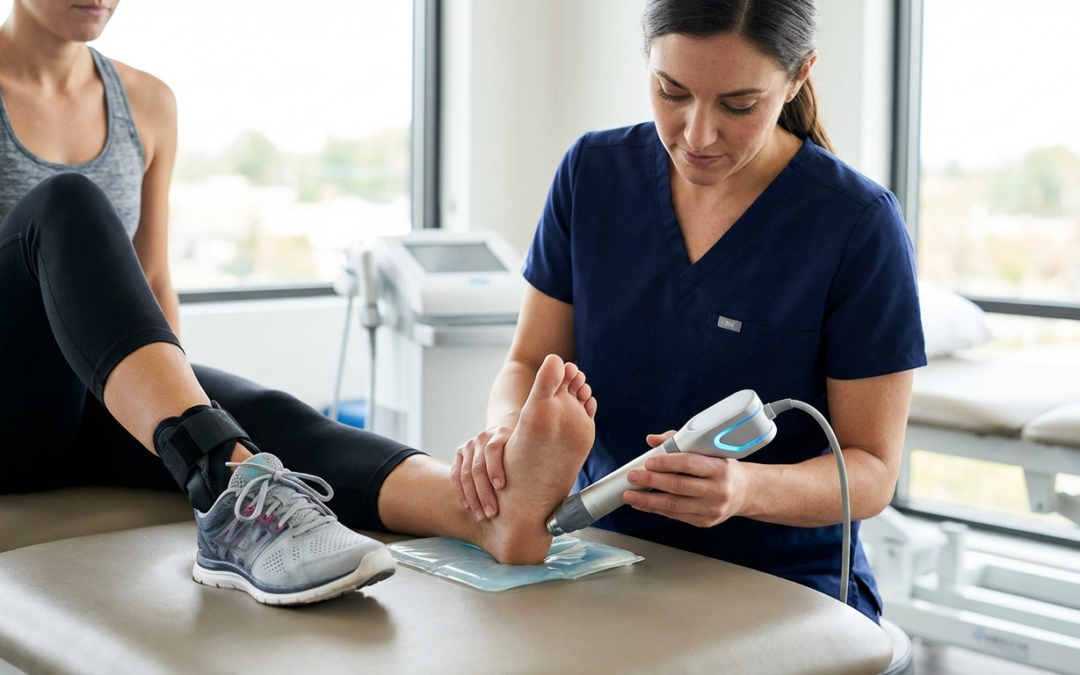
A podiatrist at a clinic like Island Foot Clinics will first conduct a thorough assessment, which may include diagnostic ultrasound, to pinpoint the exact location and severity of the injury. During the treatment, a gel is applied to the skin, and a handheld applicator delivers the acoustic waves. Sessions are typically short, often lasting between 5 to 15 minutes.
Most patients will require 3 to 6 weekly sessions to achieve optimal results. While some patients report mild discomfort during the procedure, it is generally well-tolerated. One of the biggest advantages is the lack of downtime; patients can walk out immediately after the session and resume most daily activities.
Cost and Coverage Considerations in British Columbia
The cost of shockwave therapy in British Columbia can vary. In the White Rock and Surrey area, individual sessions may range from approximately $100 to over $200. Some clinics offer packages for a series of treatments, which can be more cost-effective. While British Columbia’s Medical Services Plan (MSP) may not cover the full cost, many private extended health insurance plans offer partial or full coverage for podiatry services, including shockwave therapy. It is always recommended to check with your specific insurance provider to understand your coverage details.
Local Expert FAQ
Is shockwave therapy painful?
Most patients describe the sensation as uncomfortable but not painful. The intensity can be adjusted for comfort. With advanced focused shockwave technology, the discomfort is often less because the energy is concentrated below the skin, bypassing surface-level nerve endings.
How quickly will I see results?
While some patients report pain relief after the first session, the full benefits of shockwave therapy are realized over time as the body’s healing process unfolds. Significant improvement is typically noted after the full course of treatment (3-6 weeks) and can continue for several months as the tissue continues to regenerate.
Are there any side effects?
Side effects are minimal and temporary. Some patients may experience mild redness, swelling, or soreness in the treated area, which usually subsides within a day or two. It is considered a very safe procedure with few contraindications.
Is shockwave therapy a replacement for custom orthotics?
Not necessarily. They often work together. Shockwave therapy addresses the damaged tissue directly to promote healing, while custom orthotics (available in locations like Nanaimo and Victoria) address the underlying biomechanical issues that may have caused the injury in the first place. A comprehensive treatment plan often includes both to ensure long-term success.
Key Takeaways
- Shockwave therapy is a clinically proven, non-invasive treatment for chronic foot conditions like plantar fasciitis and Achilles tendonitis.
- Recent advancements distinguish between Radial Shockwave (for superficial areas) and Focused Shockwave (for deep, precise targets).
- The therapy works by stimulating the body’s natural healing mechanisms, including increased blood flow and tissue regeneration.
- Treatment sessions are quick, require no downtime, and have minimal side effects.
- It is an effective alternative to more invasive procedures like surgery for many patients across British Columbia.
The evolution of shockwave therapy represents a significant leap forward in podiatric medicine. For residents of White Rock and neighbouring communities like Surrey, Langley, and Abbotsford, these advancements offer a scientifically-backed path to conquering chronic foot discomfort. Professional standards now recognize ESWT as a primary treatment for many stubborn conditions, providing a faster, safer, and more effective route back to a pain-free, active life.
While we aim for accuracy, please verify details for your specific situation. For personalized advice and to discuss how these insights apply to your specific needs, we’d love to chat with you directly.
Ready to take the next step toward a life without foot pain? Contact Island Foot Clinics in White Rock to schedule a comprehensive assessment and discover if advanced shockwave therapy is the right solution for you.