
The $1,200 Ankle Twist: Why Shockwave Therapy Could Save Chilliwack Businesses Money
A simple misstep on a shop floor in Chilliwack, a trip on uneven ground at a construction site in Langley, or a slip in a busy White Rock restaurant kitchen. The result is a common, yet deceptively costly, workplace event: the sprained ankle. While often dismissed as a minor incident, the financial impact of this “simple” injury on a business’s bottom line is anything but trivial. Industry data reveals the true cost extends far beyond initial first aid, with indirect expenses often eclipsing direct medical bills by a significant margin. When accounting for lost productivity, administrative time, and the cost of replacement staff, a single ankle sprain can quietly drain a business of $1,200 or more.
In British Columbia, sprains and strains consistently rank among the most common reasons for time-loss claims filed with WorkSafeBC. These musculoskeletal injuries (MSIs) accounted for approximately 30% of all time-loss claims and over a quarter of total claim costs in recent years, representing a multi-billion dollar problem for BC employers. For businesses in physically demanding sectors across the Fraser Valley and beyond—from Abbotsford’s agricultural fields to Surrey’s manufacturing plants—finding ways to accelerate recovery and reduce downtime is a critical financial strategy. This is where modern, non-invasive treatments like Extracorporeal Shockwave Therapy (ESWT) are changing the conversation around workplace injury management.
What industry professionals know is that focusing solely on traditional recovery methods may prolong an employee’s return to full duties, compounding those hidden costs. Advanced therapeutic options offer a path to faster, more effective healing, representing a direct investment in a company’s most valuable asset: its people.
Deconstructing the True Cost of a “Simple” Ankle Sprain in Chilliwack
When an employee twists an ankle at work, the most visible cost is the WorkSafeBC claim. These direct costs, which include medical assessment fees and wage loss benefits, are what most employers focus on. However, these figures represent only the tip of the iceberg. Professional analysis consistently shows that the indirect, or hidden, costs of a workplace injury are substantially higher—potentially four times greater than the direct costs, according to WorkSafeBC estimates.
Beyond the Bandage: Direct vs. Indirect Costs
Understanding the full financial picture requires a deeper look at the cascading effects of an employee’s absence.
- Direct Costs: These are the tangible expenses covered by workers’ compensation insurance. They are straightforward and easily quantifiable, including payments for medical services and partial wage replacement during recovery.
- Indirect Costs: These uninsurable costs are where the real financial damage occurs. They include a wide range of operational disruptions:
- Lost Productivity: The injured employee is no longer contributing, and colleagues may slow down to help or take on extra duties, reducing overall team efficiency.
- Administrative Time: Supervisors and HR personnel must spend valuable time investigating the incident, completing paperwork, and managing the WorkSafeBC claim.
- Replacement & Training: A temporary or new employee may need to be hired and trained, incurring recruitment costs and a period of lower productivity as they get up to speed.
- Operational Delays: In specialized roles, the absence of a key team member can disrupt schedules, delay projects, and even lead to missed business opportunities.
- Team Morale: A workplace injury can negatively impact the morale and psychological well-being of the entire team, leading to a less engaged and productive workforce.
The Ripple Effect in Fraser Valley Industries
For key sectors in Chilliwack, Abbotsford, and Surrey, the impact is even more acute. In industries like general construction, retail, and transportation and warehousing—all identified by WorkSafeBC as having high numbers of time-loss claims—physical work is the engine of the business. A study analyzing workplace injuries found that industries like construction and transportation had some of the highest incidence rates for ankle injuries and the longest median workdays missed. In these environments, an employee on modified duties or at home recovering from an ankle sprain isn’t just an administrative task; it’s a direct impediment to revenue generation.
The Professional’s Guide to Ankle Injury Recovery: The Conventional Path and Its Limits
For decades, the standard protocol for a sprained ankle has been RICE: Rest, Ice, Compression, and Elevation. This approach is designed to manage initial pain and swelling. Following this acute phase, a worker typically undergoes a period of rehabilitation, often involving physiotherapy, to restore range of motion, strength, and balance.
The recovery timeline for a sprained ankle varies significantly with its severity:
- Grade 1 (Mild): Ligaments are stretched. Recovery often takes 1 to 3 weeks.
- Grade 2 (Moderate): A partial ligament tear. Recovery typically requires 4 to 6 weeks.
- Grade 3 (Severe): A complete ligament tear. This can take anywhere from 3 to 6 months to fully heal.
While this conventional path is well-established, it has limitations from a business perspective. A recovery period of four to six weeks for a moderate sprain represents a significant amount of lost time and productivity. Furthermore, some emerging perspectives in sports medicine question the aggressive use of ice and anti-inflammatories, suggesting they may interfere with the body’s natural healing processes. The most significant risk, however, is the potential for incomplete healing, which can lead to chronic ankle instability. The single biggest risk factor for an ankle sprain is a previous sprain, making a full and robust recovery essential to prevent re-injury and future time-loss claims.
What Recent Industry Data Reveals About Shockwave Therapy
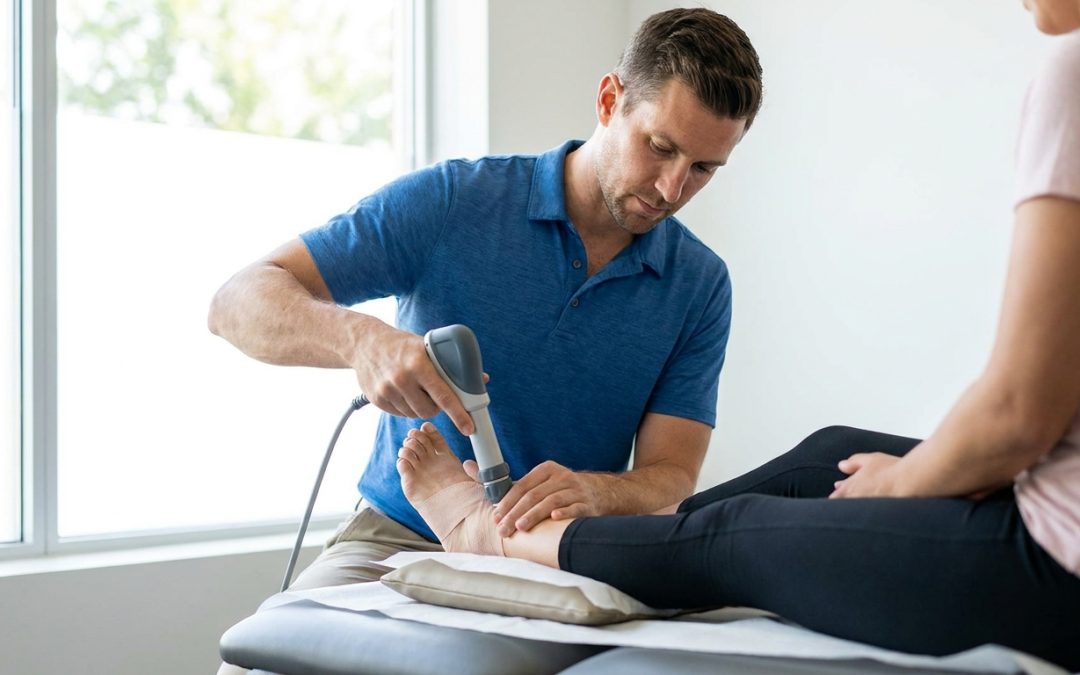
Extracorporeal Shockwave Therapy (ESWT) is a non-invasive medical treatment that is gaining significant traction in orthopedics and podiatry for its ability to accelerate healing in musculoskeletal conditions. It works by delivering high-energy acoustic waves to injured tissues, a process that stimulates the body’s own regenerative capabilities.
How Shockwave Therapy Accelerates Healing
Unlike treatments that only manage symptoms, shockwave therapy works at a cellular level. Professional standards describe its mechanism as a form of “mechanotherapy,” where mechanical stimulation triggers a biological response. Key effects include:
- Increased Blood Flow (Neoangiogenesis): The acoustic waves stimulate the formation of new blood vessels, which is critical for bringing oxygen and nutrients to the injured area to fuel the healing process.
- Stimulation of Healing Factors: The therapy triggers the release of growth factors and activates stem cells, which are fundamental to tissue repair and regeneration.
- Pain Reduction: It provides an analgesic effect by over-stimulating pain receptors and reducing inflammatory responses.
- Breakdown of Scar Tissue: In chronic cases, shockwave can help break down fibrotic or calcified tissue, improving flexibility and function.
While robust, large-scale studies on acute ankle sprains are still emerging, a 2023 update by WorkSafeBC’s Evidence-Based Practice Group noted that very low-quality evidence points toward its efficacy. The therapy is already well-supported for other soft-tissue conditions common in the foot and ankle, such as plantar fasciitis and Achilles tendinopathy, demonstrating its effectiveness on the types of tissues (ligaments and tendons) affected in an ankle sprain.
The Business Case: Reducing Downtime with Shockwave Therapy in Chilliwack
From an employer’s standpoint, the primary benefit of shockwave therapy is its potential to significantly shorten the recovery window. By accelerating the body’s natural healing cascade, an employee may be able to return to full, unrestricted duties faster. This translates directly into reduced indirect costs—less lost productivity, lower administrative burden, and a quicker return to operational normalcy. Investing in a course of `Shockwave therapy Chilliwack` or `Shockwave therapy Penticton` for an injured employee can yield a substantial return by minimizing the duration of costly downtime.
Implementing a Proactive Foot & Ankle Health Strategy in Your BC Business
While effective treatment for injuries is crucial, a truly cost-effective approach focuses on prevention. Many workplace ankle sprains are not random accidents but the result of underlying biomechanical issues or foot conditions that create instability.
Leading podiatry professionals across British Columbia report that a proactive foot health strategy is one of the most effective ways to reduce the risk of lower limb injuries. This involves looking beyond safety boots and considering the foundation of a worker’s stability: their feet.
A key component of this strategy is the use of prescription medical devices. `Custom orthotics Nanaimo` and `Custom orthotics Victoria` are not merely arch supports; they are devices engineered to correct biomechanical faults like overpronation (feet rolling in) or supination (feet rolling out). By ensuring proper foot alignment, custom orthotics can:
- Evenly distribute pressure across the foot, reducing fatigue.
- Improve balance and stability, decreasing the risk of slips and twists.
- Reduce strain on the entire kinetic chain, from the ankles to the knees, hips, and lower back.
- Prevent the progression of conditions like bunions and flat feet that can compromise stability.
For businesses in Vernon, Courtenay, and Cranbrook, encouraging employees in physically demanding roles to seek a professional assessment from a `Foot pain specialist Victoria` or `Podiatrist Kelowna` can be a powerful preventative measure. Addressing underlying issues like chronic `Foot pain Kelowna` or `Bunions treatment Victoria` before they contribute to a time-loss injury is smart, preventative management.
Local Expert FAQ: Shockwave Therapy and Workplace Injuries
Q: Is shockwave therapy covered by WorkSafeBC?
A: It can be. When shockwave therapy is delivered by a registered physiotherapist or podiatrist as part of an approved treatment plan for a workplace injury, it is often covered. However, WorkSafeBC guidelines state that providers cannot bill extra for the modality itself. It is essential to confirm coverage details for each specific claim.
Q: How many shockwave sessions are typically needed for an ankle injury?
A: Most treatment protocols for musculoskeletal conditions involve 3 to 5 sessions, spaced about a week apart. The exact number depends on the severity and chronicity of the injury. Each session is relatively short, often lasting 10 to 20 minutes.
Q: Is the treatment painful?
A: Patients may experience some discomfort during the procedure as the acoustic waves target the injured tissue, but it is generally well-tolerated. The intensity can be adjusted for patient comfort. Any discomfort typically subsides quickly after the session is over.
Q: Can shockwave therapy help an employee with old, chronic ankle pain?
A: Yes, shockwave therapy is often highly effective for chronic conditions where the body’s healing process has stalled. It can help to re-initiate the healing cascade, break down scar tissue, and provide relief for long-standing issues, making it a valuable tool for addressing nagging injuries that impact an employee’s performance.
Key Takeaways
- A “simple” workplace ankle sprain can cost a business over $1,200 when accounting for hidden costs like lost productivity and administrative time.
- Sprains and strains are a leading cause of WorkSafeBC time-loss claims in British Columbia, representing a significant financial burden on employers.
- Conventional recovery for a moderate ankle sprain can take 4-6 weeks, leading to prolonged employee downtime.
- Shockwave therapy is a non-invasive treatment that accelerates the body’s natural healing processes, potentially shortening recovery time.
- Proactive injury prevention through professional podiatric assessment and interventions like `Custom orthotics Penticton` can address underlying issues and reduce the risk of ankle injuries.
For businesses in Chilliwack and across British Columbia, managing workplace injuries effectively means looking beyond the conventional. Adopting advanced treatments like shockwave therapy is not an added expense but a strategic investment in minimizing downtime, controlling costs, and supporting the health and productivity of your workforce. By pairing effective treatment with proactive prevention, you can protect both your employees and your bottom line.
While we aim for accuracy, please verify details for your specific situation. For personalized advice and to discuss how these insights apply to your specific needs, we’d love to chat with you directly.
To learn how a proactive foot health strategy, including advanced treatments like Shockwave Therapy, can benefit your Chilliwack-area business and help your employees recover faster, schedule a consultation with the experts at Island Foot Clinics today.